Friday, 22 November 2013

Well the solo show has been and gone - it was such a great opening night, I had no idea it would be so much fun... 

I had been preparing for the opening night for months so needed to de-focus somehow... I spent the whole of the day before making food for the night, we had ginger prawns with pineapple and chilli, quails eggs scotch style with smoked haddock & hollandaise, brie and walnut scones with cranberry, and mini chocolate & vanilla cupcakes, all washed down with plenty of bubbles and vats of red wine for those who preferred it... My only regret was not being able to spend enough time with everyone, it was all a bit of a blur and as my good friend Emma Taylor pointed out 'Probably the closest thing you will ever get to a wedding'...!

All in all it was a great night and the show was as much of a success as an artist can admit to... I think you always look at your work from a critical point of view. For example my favorite works did not sell (this always seems to happen) but I have been left feeling that I just want to produce more and more, and have some ideas that are just bursting to come out as a result of seeing my work on the wall for a number of weeks... I have also had some really positive feedback, some great sales and my show was visited by some really interesting people, so thank you all for coming!

One of the other great things is that the Woolff Gallery always produces a short film for the artists and their exhibitions, so I have a short film on you tube which shows me talking about my work, and some of my ideas and inspiration along the way... It was made my my fabulous sister Prano Bailey-Bond who is an award winning film maker based in London. I hope you enjoy it! Next stop Art Miami in December...

Please click on the link below to view the short film....


Tuesday, 10 September 2013

Solo exhibition 'Wonderland' at Woolff Gallery!!

So, at last I have a solo exhibition - the date of the opening is the 3rd October, from 6-9pm...

I have received my catalogue back today so that will be posted out tomorrow - I will post a link to it here very soon, in the meantime if you would like any information or an invite to the show please contact info@woolffgallery.co.uk. 

I hope to see you there.... Watch this space for more news over the next couple of weeks!


Friday, 8 March 2013

WOOLFF GALLERY PRESENTS ZAC FREEMAN


Here is a film about Zac Freeman, THE incredible junk portrait artist.... I was general assistant/runner/weather watcher & toilet finder(!) on the Woolff Gallery shoot for his film....

Zac Freeman lives and works in Jacksonville Florida and we spent 4 fabulous days with the artist, his friends & family (& his cats) learning about his processes and inspiration. Please watch the film, but I have also written a basic outline of the films story for anyone that wants words...


Zac Freeman


Just like a regular artist uses different sized brushes to create their paintings, Zac Freeman uses different sized objects to create his junk portraits.

Zac Freeman 'Justin'. This is the artwork he was working on in the film


Choosing to create only portrait work in a sense limits the artistic story, however if you are going to tell a story & use less words, each one of those words means a whole lot more. By using junk as his medium Zac Freeman feels that the story can be broadened, we can read a lot more into his work by looking at the individual objects in each artwork than we could if we were looking at a portrait created using just paint, or pencil. Looking at the objects tells us details about the subject and their life when close up, and when we stand away from the artwork we see the portrait and the image of the person very clearly.

Artwork detail

The objects Zac uses come from all sorts of places, they are often collected by the subject, or by friends and family and given to Zac, nothing is purchased by the artist. Zac feels that every object he uses has its own energy & history, he would never alter an object or change the objects in anyway whatsoever, the pieces have their own individual story and now they will be used in an artwork and given new life. 


The connection between objects and people is obvious, we all use objects every day and to create a portrait using objects that relate to, or have been owned by one of Zac Freeman's subjects creates a connection by giving the viewer a visual piece of the subjects life.


Zac is often given bags of junk by people which he then processes in his studio – he would need to wash all of the objects otherwise the glue will not stick to them, he then sorts them into different colours, and from there into size. Each object is categorised by colour and size & stored in crates in the studio.  He likes these objects to be organised and have its place.

Filming Zac in his studio, with his work to the bottom right of the image


Zac started creating portraits using just black, white & neutrals but he quickly saw the need to add colour into his work, the studio has shelves and shelves of crates all organised into their different categories.

Zac Freemans first assemblage artwork 'Dave'

Zac Freeman's first assemblage artwork ‘Dave’ (one of Zac’s best friends) – was made out of Zac’s personal possessions, things that he had collected or hoarded for many years. For example there was a chain from a bicycle the Dave himself had broken. Dave says that when people look closely at the work what they see is junk, but what Dave sees is memories and reminders of the things that the two of them did when they were growing up together.


Technology and objects change so fast in this world, for example initially everyone had 8-track tapes, then everyone had cassette tapes, then CD’s, then it goes to digital & what do we do with all of those things? One of the things that Zac has used since the beginning is black film cannisters, initially these were readily available however these are becoming more and more rare since the introduction of the digital camera. This gives Zac's work an added dimension in that they become a kind of time capsule, in years to come many of the objects will be obsolete.


'David'

Zac takes all of his own photographs for his artworks. He tries to capture several emotions in one instance for his portraits. He likes the viewer to see the finished portrait in different ways – it could be pensive, or deep in thought, he leaves it open so that the portrait can be read in many ways, the viewer may project their own emotions onto the portrait rather than there be an obvious mood or emotion. He would initially take around 100 photographs and out of these hopefully one would be useable. These are then gridded and marked in relation to the canvas, and work commences. Zac works close up on these portraits which is incredible, there are no cameras or computers involved in the process, it is a simple and unique process.


The artworks take up to three months to create, they are never built sculpturally correct, the nose will not necessarily protrude it may be flat & the cheeks protrude. 

'Mikee'


The narrative that Zac Freeman is trying to create is about everyday people & everyday objects, its about us in this time and this place – it about our culture and the reflection of us in the things we use & the things we throw away. The objects used they are the things that very often inhabit our lives from the time we are young to the time we die.


Zac is influenced by life, our culture and what is happening around us, his inspiration all just comes from life. He enjoys the idea of someone looking at the artwork many years from now, and thinking about what they would think about the objects he has used. Something he has put on an artwork today looks reasonably common, but in 100 years from now it will be completely archaic, so old – people will not be able to believe we used phones like the one we use. The artworks save a time and place, they represent our culture & how we lived just through the objects that we all use every day. Any portrait that comes out of Zac’s studio is a story, all of it happened and it is there in the artwork for you to read.

'Steve' (my personal favorite!)
Zac Freeman's work has recently been seen on banners & billboards across London. He was selected to create an artwork for the Absolute Vodka campaign.


Zac Freeman in the spot where he designed his Absolut Vodka artwork - in his local bar 'Pete's'

Absolute artwork in Zac's studio, ready to ship.

Zac Freeman's Absolute artwork on a banner on Shoreditch high street, London


Sunday, 17 February 2013

Here are a few of my latest pieces, again created using vector prints, collage & 1000 & 1000's of tiny little tubes. I am pleased with these pieces, starting to build ideas for a solo show hopefully towards to end of the year...


Monday, 19 November 2012

My work

I thought it was about time I shared some of my latest artwork. I have recently gone back to my roots in that I am really enjoying creating pop-art style/psychedelic patterns, the only difference now is that they are immaculately presented inside museum quality perspex cases and using 1000's of tiny tubes a long with reflective material I am creating a vision altering artwork...

I am waiting for my website to be updated so that I can upload my work to that, but in the meantime here are a few images:

 Susila Bailey-Bond, 'Kabam, wham, boom!' 120 x 53cm, mixed media

Susila Bailey-Bond, 'Bosh', 53 x 53cm, mixed media
Susila Bailey-Bond, 'Pow', 53 x 53cm, mixed media
Susila Bailey-Bond, 'Boooom!' 53 x 53cm, mixed media
My work is sold through Woolff Gallery, London: www.woolffgallery.co.uk - the next art fair I will be exhibiting at is London Art Fair 2013. 

Saturday, 12 May 2012

May Day in NYC with artist Oona Hassim

Oona Hassim is a London based artist who exhibits her work with Woolff Gallery, London. We have known each other for a few years now & I absolutely love her work. 

Oona is a very talented painter who won a scholarship from St Martins, she focuses on crowds & the way they pass through the city. Her recent work has observed the demonstrations and marches which took place throughout London last year, she looks at the way in which these crowds are restrained and the way that they can never move freely due to marshaling and the police.

Oona was painting in New York, and whilst there it happened to be May Day so I accompanied her on the May Day rallies. We started our day in Williamsburg, and walked over the bridge into Manhattan, I was quite nervous due to the fact that the bridge walkway was caged-in. Having experienced 'kettling' in London I had a fear that the police would trap us and hold us until the end of the day which would have meant the end of Oona's drawings of the demos. Luckily my fears did not materialise & the demonstration continued peacefully through the city until it ended up in Union square. Here are a few pictures of the day, including a couple of shots of Oona's drawings that she will take back to London and use as the basis for her incredible oil paintings.

Police in Williamsburg

The small crowd in Williamsburg

The march over Williamsburg Bridge


We jumped ahead of the crowd...

The police lead the way!

Oona was jumping up onto the bridge's vantage points - just a step up, or hanging off part of the railing to get a better of a view of the crowd - we were firmly told to "Get down, or you'll be off too", by the police - meaning we would join the recently arrested protestors if we didn't play by the rules... And we marched on to Union Square.


Union Square

We found a 1st floor window where we had a great view of the crowd. Oona had to make a guerilla style sketch here as we were not really supposed to be there, despite the time constraints, it was still an amazing drawing!


Oona's 10min sketch of Union Square
This just shows how talented this artist is! Honestly - 10mins... Exceptional.


Colourful crowds in Union Square


Occupy's balloon camera
I loved this! What a beautiful way to make a film... The Occupy group were filming the protest using a colourful bunch of balloons with a film camera hanging underneath. It hovered above the crowd, just keeping an eye on things.


The police in Union Square
The police haven't utilised quite such a beautiful way of observing the crowds... 


Our view over Union Square
Oona's sketch of Union Sqaure

Being with Oona makes you view crowds differently. You see them more as a mass rather than as individuals. You feel the power of the crowd as if it were one animal. You watch the way that the crowd flows, as if it were a river of people running through the city... There is an engulfing feeling that you experience when you are in the middle of a demonstration, or on the other hand the celebratory feeling & party like atmosphere. Oona is passionate about getting this across within her work.

I think its amazing that someone is out there, doing this. There are 100's of photographers (which is good as it can make things safer) but only one girl drawing with her pastels & sketchbook. Its the way that news was reported to us in the old days, through drawings and paintings, but due to the camera & technological advances it is no-longer necessary. Oona is a true artist, capturing these historical events in a timeless medium.

Oona's work can be seen at: http://www.woolffgallery.co.uk/

A short film of her drawing at Occupy London can be viewed by clicking this link:

Union Square 1st may 2012


Wednesday, 4 April 2012

Damien Hirst Retrospective - Preview - 3rd April 2012


Last night I was fortunate enough to attend to the Private View of Damien Hirst’s retrospective at London’s Tate Modern. Now I am well aware that this artist is not everyone’s ‘cup-of-tea’ but as for me, well I felt like it was the adult version of Christmas…. Despite all of the controversy surrounding Damien Hirst this is a truly fascinating exhibition, there are some stunningly beautiful artworks on display, and an element of playfulness and fun as you walk through the rooms.

After propping up the bar for a glass of wine, Prano Bailey-Bond & I embarked upon the first room where we met up with our good friend & assistant curator of the exhibition Loren Hansi Momodu.  This first room contains a selection of Hirst’s very first exhibition artworks. These works were on display at the warehouse exhibition ‘Freeze’ in 1988 whilst he was a student at Goldsmiths. There is a vast ‘Spot Painting’, which is propped up against a wall, a set of gloss painted pots & pans hanging in a row, and an amazing construction of brightly painted boxes which fit snugly into the corner of the room. This installation (aptly named ‘Boxes’) was apparently sold for £500, but as Hirst was unable to make them to the client’s requirements he smashed them up. Rumour has it that he never re-paid the £500 to the client…

Detail - First spot painting (1988)
'Boxes' (1988)

The ‘Freeze’ exhibition in 1988 may not have brought Hirst the recognition as an artist that he was hoping for, but when you look at the work on display in this first room there is a feeling of a ‘beginning.’ His bold colours & conceptual style is apparent, albeit in a rather ‘studenty’ way. Hirst apparently worked tirelessly building, creating & promoting this first warehouse show with a massive focus on getting the right people through the door, his aim was to make people stop – even in these fledgling years he must have realised that being an artist is not just about the art itself, it is also about getting people to talk about you.

His fellow YBA’s apparently came out with more results than Hirst himself, but nevertheless he continued… Refining the ‘Spot Paintings’ by using a compass. This is what we see in the next room – a series of spot paintings where if you look closely there is a tiny hole in the centre of the spot – these are the works we know Hirst painted himself. There have since been around 1400 'Spot paintings’, all painted by assistants – but then it’s not exactly the Sistine Chapel… Michelangelo’s assistants would have had a tougher challenge ahead of them without doubt. In this 2nd room there are also the early medicine cabinets, with their age-defiant packaging these artworks do not seem at all dated – a mean feat when you consider the branding & re-branding of virtually every product available to us these days.

The medicine cabinets were developed as a commentary on his mother’s faith in modern medicine, but her lack of faith in modern art. Apparently there is a pattern in the positioning of the drugs in that they correspond to different conditions & then extend to partial organs or parts of the body.

We also see ‘A Thousand Years’ (1990) which was purchased by Charles Saatchi. This is a glass case containing a putrid life cycle. A severed cows head on one side, which lies below an insect-a-cutor, and a minimal white box breeding maggots & flies on the other. The holes cut in the dividing plexiglass screen release the stench of death to the flies and tempt them across to their bounty, or fate. Not something I would want (or could fit) in my living room, but a witty and shocking microcosm of a world – the sort of thing that you would need to be brave, morbid & not afraid of getting your hands dirty in order to create.

'A Thousand Years' (1990) detail
There are also the fish cabinets ‘Isolated elements swimming in the same direction for the purpose of understanding’ left & right, the sheep in formaldehyde: ‘Away from the flock’ (1994), & ‘Stimulants (and the way they affect the mind and body) (1991) in this room.

The next real treat for me was the famous shark. Now then, we have just been gazing at an oozing bloody cows head crawling with flies lying on the wooden floor of the Tate Modern, it leaves me thinking that if the title to the shark, ‘The physical impossibility of death in the mind of someone living’ (1991), was not precisely true then the entire gallery would have emptied - with all of the visitors puking & fainting as they run for the nearest exit. So it makes sense. It appears that it is impossible for us to see this shark as either dead, or frightening – of which we know it is both – in this form, and with us being alive we can only see this as an object, your mind does not allow you to see this as anything else. This is something I want to see again.

'The physical impossibility of death in the mind of someone living' (1991)
Then we see more pharmaceutical cabinets containing pills & tablets, a feat of repetition and beautiful in its simplicity & presentation. ‘Lullaby’ apparently represents the link between the songs we sing to send children to sleep & the effect that a sleeping pill has on an adult – a grown up ‘Lullaby’. These cabinets are beautiful, the colours are soft and I find them aesthetically fascinating.

Now we were lucky enough to by-pass the huge queue for the butterfly room, although we whizzed passed ‘The acquired inability to escape’ as a result. To be honest this installation of a chair, a table & some cigarettes pushes the boundaries a bit too much for me – it borders on taking the p**s. Unfortunately I don’t get this, nice steel cabinet though – he could re-use that. We also whizz past a repetition of cigarette butts called 'Dead ends die out', to be honest I have never seen cigarette butts look so beautiful.

'Dead ends dry out, examined' (1993)
And then we get closer to the butterfly room. We are in a room with brightly coloured panels which have dead butterflies fixed to them. On the table sit full ashtrays. This contrast of beauty and horror is the re-occurring theme, which thread together Hirst’s work.

For his first ever solo show in 1991 Hirst transformed a 2-story commercial building into the installation ‘In and out of love’. This has been re-created at Tate Modern. Once we exit the panelled walls we find ourselves in a humid room full of live butterflies. The pupae are attached to large white canvasses on the wall and as the butterflies are born they leave an empty cocoon & a line of liquid, which runs down the canvas. Then the insects feast on sugar and rotting fruit, getting drunk in the process, until they meet their end. I almost wanted these 2 rooms to be the other way around as you enter a room with an uncomfortable feeling of the creation of life, and then you walk into a room where death is used for beauty.

'In and out of love' (re-created)
I could hear people asking each other what the difference is between this and a butterfly farm, well there is none and I expect that butterflies in a farm would be better taken care of – but the pupae dribble on a canvas, that is something you wouldn’t see at a farm, is that art? It has to be said that it is a brave move, the raggedy insects will receive external support & I wouldn’t be surprised if the Tate have a battle on their hands to keep this room open. But it is beautiful, bright & gentle and displays simple contradictions – but more than anything it is a great way to get people talking, creating controversy and making headlines – something of which Hirst is the master…

As we exit the butterflies we find ourselves in the ‘Pharmacy’. This installation was created in 1992; again the clinical ordering within the cabinets is a repetitive dream. The packaging has not dated, despite it being 20 years old. There are drugs and pills available for anything & everything, but regardless of this we are all going to die anyway ‘you can only look after people for so long’.

'In the Pharmacy'
The ‘Spin Paintings’ are up next, they are enormous rotating panels, covered in bright gloss paint  - in the centre of the room is a beach ball hovering over a jet of air 'Loving in a world of desire' (1996) - a bigger, better & more refined version of the Ping-Pong ball & hairdryer installation 'What goes up must come down' (1988). This room is colourful & playful, there is an element of the funfair in here and it seems hard to take yourself too seriously in these surroundings…

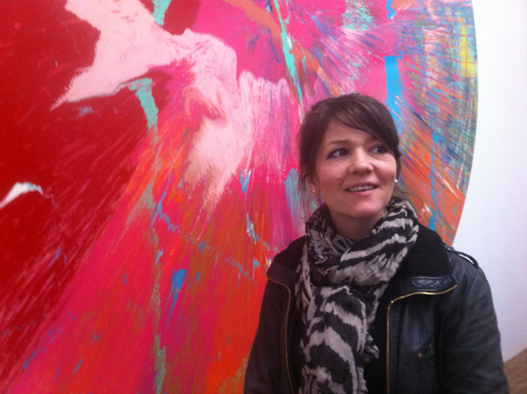
Susila with a spin painting
'Loving in a world of desire' 1996 (with spin painting in background)
The next room contains ‘Mother & child divided’. This work to me is not pretty, the animals themselves are beautiful, but when you stand between the two halves of the installation it appears that there is an unborn calf in the cows womb. The inner flesh is brown & looks like fabric, it is both amazing and unpleasant at the same time. Another controversy but by now we have all had time to make our minds up.

'Mother and child divided' (copy 2007) detail
The super large ashtray 'Crematorium' is next, brimming with cigarette butts another reminder that death is inevitable – although I believe Hirst has given up smoking now, I wonder if smoking is one of the CV requirements of his helpers...?

We had to speed up then as we were dawdling, so had a brief encounter with another shark, saw ‘Lapdancer’ (some cabinets containing surgical instruments) & made a bee-line for the room containing the most majestic artworks. Created using butterfly wings and dead butterflies these incredible mandala style artworks are like fragile stained-glass windows – the geometry and maths that have been used to create these works is apparent and should not be overlooked. They are bright and elegant, a natural beauty encouraged into form by a person with a vision – a lot of butterflies died to make these works.

'I am become death, shatterer of words' (2006)
In the old days people collected dead butterflies, and they were boxed and displayed. Here these dead insects are re-born in a way that would have encouraged even the toughest atheist into belief in God's big house. I could spend hours looking at these, first up-close observing the perfection of nature within a butterflies wing, then stepping back and seeing the orchestrated perfection forced and created by man. It is also contradictory that Hirst nods to Buddhism through the mandala like forms in these works although the works are created by death.

Unfortunately we didn’t have time to see the diamond encrusted skull (although I do have a print of this at home – cheers Cartrain!) and I have to say that I feel as though I have seen this before thanks to the press. I will need to go back to see this in the flesh…. As we were herded passed ‘Black Sheep’ & ‘Black Sun’, we were stopped in our tracks by ‘The Incomplete Truth’, I have never seen this before – it was a complete surprise and I loved it! The dove is suspended in flight in a tank of formaldehyde. The dove, a symbol of peace, a messenger of hope, whatever…. For me it was a stunning end to the show, a beautiful image, a gentle form taking off before your eyes.

'The Incomplete truth' (2007)
This exhibition encapsulates opposites & contradictions – some simplistic and obvious (but then Hirst got there first), and sometimes these contradictions dive a little deeper but I think Hirst wants you to believe what you want from his work. I have grown up with art by Hirst and whether you want to acknowledge it or not his work has inspired 1000's of designers & artists across the globe. Hirst may not be able able to draw - an idiots gauge as to whether you are good at ‘art’ - but he is outstanding at creating a storm and a fuss.. He is clearly an excellent businessman, has incredible determination, and has a superb ability to surround himself with the right people. I suspect that he can be arrogant and that he sometimes borders on the nouveau riche - and it cannot be possible to achieve what Hirst has achieved by being ‘nice’. He has bulldozed his way through the art world & left things of beauty & shock in his wake, earning himself the label of the worlds richest living artist. One thing you cannot deny him is – The boy from Leeds done good! 

Mr Hirst - I salute you. 
Susila.

You can't get much more Hirst than that!
PS – on my journey to work this morning I stepped over a cigarette butt on the pavement. Seeing it lying there instantly brought my mind to Damien Hirst’s work. So yet again I find myself in an instance where art overrides life - in the same way as whenever I see a UK bobby-on-the-beat I think of Banksy….